
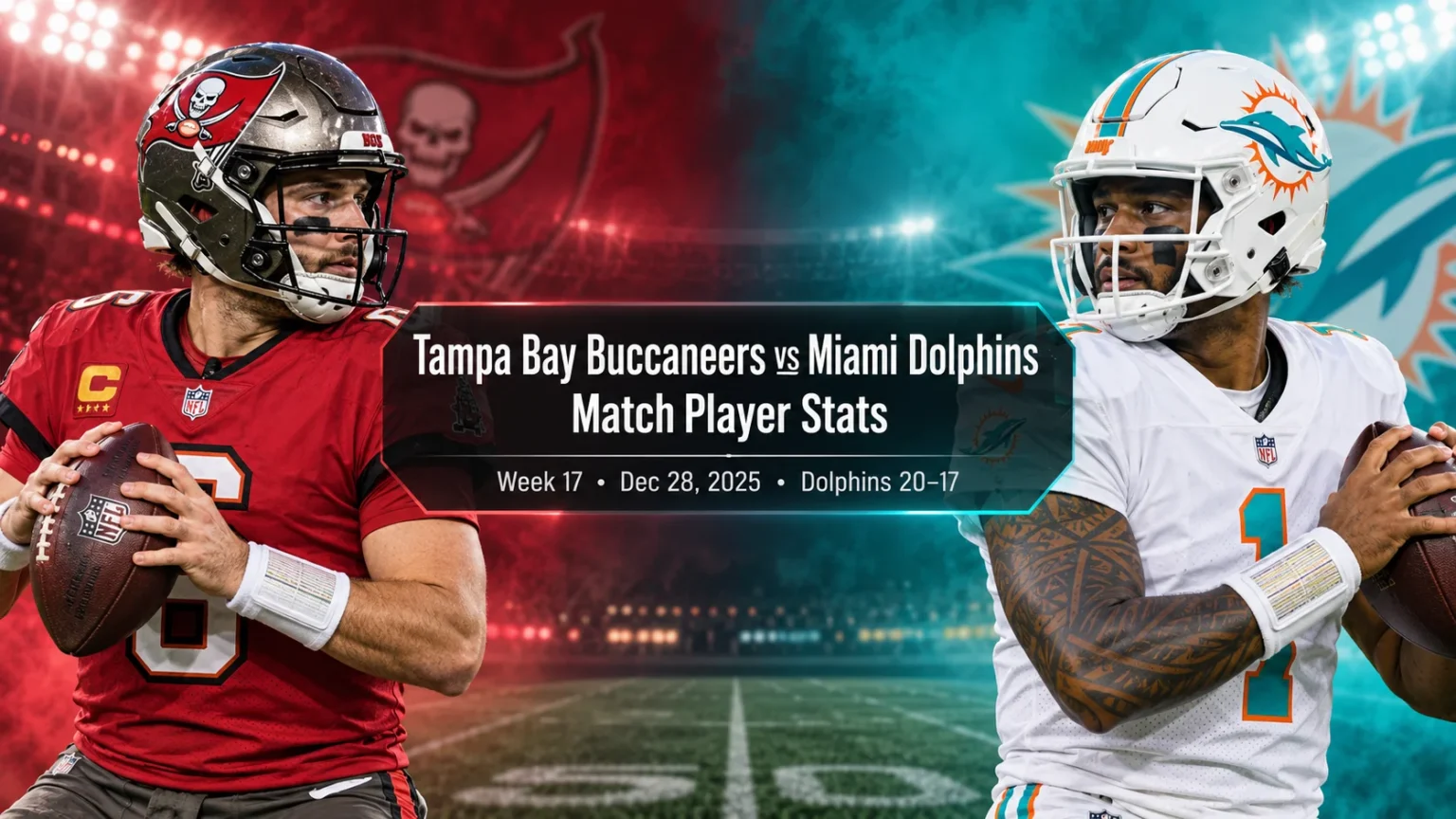
The most recent completed regular-season meeting between the Tampa Bay Buccaneers and Miami Dolphins took place on December 28, 2025, during Week 17 of the 2025 NFL season at Hard Rock Stadium in Miami Gardens, Florida.
Miami defeated Tampa Bay 20-17 in a game that provided an unusual statistical contrast. The Buccaneers finished with 380 total yards compared with Miami’s 298, while Baker Mayfield threw for 346 yards and two touchdowns. Yet three Tampa Bay turnovers — two interceptions and one lost fumble — gave Miami the decisive advantage.
Dolphins rookie quarterback Quinn Ewers, making his second consecutive NFL start, completed 14 of 22 passes for 172 yards, two touchdowns and no interceptions. Miami also produced 145 rushing yards, allowing the Dolphins to play with greater offensive balance and protect their lead.
The Tampa Bay Buccaneers vs Miami Dolphins match player stats ultimately tell a simple story: Tampa Bay generated more yardage, but Miami protected the football, created takeaways and made enough explosive plays to win.
Buccaneers vs Dolphins Game Information
| Detail | Information |
|---|---|
| Matchup | Tampa Bay Buccaneers at Miami Dolphins |
| Date | December 28, 2025 |
| Competition | 2025 NFL Regular Season |
| Week | Week 17 |
| Venue | Hard Rock Stadium, Miami Gardens, Florida |
| Final Score | Dolphins 20, Buccaneers 17 |
| Halftime Score | Dolphins 17, Buccaneers 7 |
| Tampa Bay Record After Game | 7-9 |
| Miami Record After Game | 7-9 |
Score by Quarter
| Team | Q1 | Q2 | Q3 | Q4 | Final |
|---|---|---|---|---|---|
| Tampa Bay Buccaneers | 7 | 0 | 3 | 7 | 17 |
| Miami Dolphins | 7 | 10 | 0 | 3 | 20 |
Tampa Bay struck first, but Miami responded quickly and controlled the middle portion of the game. The Dolphins carried a 17-7 lead into halftime and later extended their advantage to 20-10 before the Buccaneers scored with 50 seconds remaining.
Tampa Bay Buccaneers Player Stats
Baker Mayfield Passing Stats
| Player | Comp/Att | Pass Yards | TD | INT | Sacks | Rating |
|---|---|---|---|---|---|---|
| Baker Mayfield | 33/44 | 346 | 2 | 2 | 3 | 93.6 |
Mayfield’s final passing total was impressive on the surface. He completed 75 percent of his attempts and topped 300 yards while producing touchdown passes to Chris Godwin Jr. and Mike Evans.
The turnovers, however, changed the value of those numbers.
Mayfield threw two interceptions and also lost a fumble during the fourth quarter. Miami converted Tampa Bay’s mistakes into field position and denied the Buccaneers opportunities to complete their comeback.
The first Tampa Bay touchdown came on a five-yard pass from Mayfield to Godwin after an efficient 14-play opening drive.
Late in the game, Mayfield again moved the offense quickly. Tampa Bay drove 91 yards in only three plays, highlighted by a 59-yard Godwin reception before Mayfield found Evans for a four-yard touchdown that reduced Miami’s lead to 20-17.
The Buccaneers could not recover the ensuing onside kick.
Tampa Bay Rushing Stats
| Player | Carries | Yards | Average | TD |
|---|---|---|---|---|
| Bucky Irving | 9 | 19 | 2.1 | 0 |
| Baker Mayfield | 3 | 16 | 5.3 | 0 |
| Rachaad White | 2 | 10 | 5.0 | 0 |
| Sean Tucker | 2 | 8 | 4.0 | 0 |
| Team Total | 16 | 53 | 3.3 | 0 |
Tampa Bay’s inability to establish the running game was one of the biggest statistical differences between the two teams.
The Buccaneers managed only 53 rushing yards on 16 attempts, with Bucky Irving limited to 19 yards on nine carries.
That lack of production put more responsibility on Mayfield and the passing offense. Tampa Bay attempted 44 passes while running the ball only 16 times.
Miami, by comparison, carried the football 30 times.
Buccaneers Receiving Stats
| Player | Receptions | Targets | Yards | TD |
|---|---|---|---|---|
| Jalen McMillan | 7 | 9 | 114 | 0 |
| Chris Godwin Jr. | 7 | 8 | 108 | 1 |
| Cade Otton | 4 | 4 | 33 | 0 |
| Mike Evans | 3 | 7 | 31 | 1 |
| Emeka Egbuka | 3 | 5 | 20 | 0 |
| Tez Johnson | 2 | 2 | 19 | 0 |
| Bucky Irving | 5 | 6 | 14 | 0 |
| Rachaad White | 2 | 2 | 7 | 0 |
Jalen McMillan Leads Tampa Bay
Jalen McMillan finished as Tampa Bay’s receiving-yardage leader with seven catches for 114 yards.
His production included multiple downfield plays, and he recorded 79 receiving yards before halftime. McMillan’s 114 yards represented one of the strongest individual performances in Tampa Bay’s offense despite the defeat.
Chris Godwin Delivers a Big Game
Godwin was equally important, catching seven of eight targets for 108 yards and one touchdown.
His five-yard touchdown reception opened the scoring, while his 59-yard fourth-quarter catch helped set up Tampa Bay’s final touchdown.
Godwin and McMillan combined for 222 receiving yards, accounting for a large portion of Mayfield’s passing production.
Mike Evans Scores Late
Evans had a relatively quiet afternoon in terms of volume, finishing with three catches for 31 yards.
His final reception was crucial, however.
Mayfield connected with Evans for a four-yard touchdown with 50 seconds remaining, cutting Miami’s lead from 20-10 to 20-17.
Miami Dolphins Player Stats
Quinn Ewers Passing Stats
| Player | Comp/Att | Pass Yards | TD | INT | Sacks | Rating |
|---|---|---|---|---|---|---|
| Quinn Ewers | 14/22 | 172 | 2 | 0 | 2 | 118.0 |
Ewers did not need the passing volume Mayfield produced.
Instead, the Dolphins quarterback played efficiently and avoided the game-changing errors that hurt Tampa Bay.
He finished with two touchdown passes and no interceptions, posting a 118.0 passer rating.
His biggest completion came during the first quarter.
After Tampa Bay had taken a 7-0 lead, Ewers connected with Theo Wease Jr. for a 63-yard touchdown, immediately tying the game.
Ewers later threw an 11-yard touchdown to tight end Greg Dulcich with 1:43 remaining in the second quarter, giving Miami a 17-7 halftime advantage.
Miami Dolphins Rushing Stats
| Player | Carries | Yards | Average | TD |
|---|---|---|---|---|
| De’Von Achane | 18 | 83 | 4.6 | 0 |
| Jaylen Wright | 5 | 56 | 11.2 | 0 |
| Jaylen Waddle | 1 | 7 | 7.0 | 0 |
| Quinn Ewers | 4 | 5 | 1.3 | 0 |
| Malik Washington | 1 | 1 | 1.0 | 0 |
| Greg Dulcich | 1 | -7 | -7.0 | 0 |
| Team Total | 30 | 145 | 4.8 | 0 |
Miami’s rushing attack gave the Dolphins something Tampa Bay lacked: consistent offensive balance.
De’Von Achane led the team with 83 yards on 18 attempts.
Jaylen Wright provided an important complementary performance, gaining 56 yards on only five carries, including a 32-yard run.
As a team, Miami averaged 4.8 yards per rushing attempt.
The Dolphins did not score a rushing touchdown, but the ground game helped sustain possessions and reduced the number of situations in which Ewers had to carry the offense.
Miami Receiving Stats
| Player | Receptions | Targets | Yards | TD |
|---|---|---|---|---|
| Theo Wease Jr. | 1 | 1 | 63 | 1 |
| Greg Dulcich | 5 | 6 | 58 | 1 |
| De’Von Achane | 3 | 3 | 29 | 0 |
| Julian Hill | 1 | 2 | 16 | 0 |
| Cedrick Wilson Jr. | 1 | 2 | 8 | 0 |
| Malik Washington | 1 | 3 | 4 | 0 |
| Darren Waller | 1 | 3 | 0 | 0 |
| Jaylen Waddle | 0 | 1 | 0 | 0 |
Theo Wease’s stat line is a good example of why raw reception totals do not always reflect impact.
Wease caught only one pass, but that reception produced a 63-yard touchdown and immediately erased Tampa Bay’s early lead.
Dulcich was Miami’s most consistent receiving option. He caught five passes for 58 yards and a touchdown, providing Ewers with a reliable target underneath and in the red zone.
Buccaneers vs Dolphins Team Stats
| Category | Buccaneers | Dolphins |
|---|---|---|
| First Downs | 21 | 13 |
| Total Net Yards | 380 | 298 |
| Net Passing Yards | 327 | 153 |
| Rushing Yards | 53 | 145 |
| Offensive Plays | 63 | 54 |
| Yards Per Play | 6.0 | 5.5 |
| Third Down | 6/13 | 4/12 |
| Fourth Down | 2/2 | 0/0 |
| Turnovers | 3 | 0 |
| Penalties | 5-45 | 10-77 |
| Red-Zone TD Rate | 2/3 | 1/3 |
| Time of Possession | 32:06 | 27:54 |
This table shows why the final score cannot be explained by yardage alone.
Tampa Bay had:
- More total yards
- More passing yards
- More first downs
- Better third-down efficiency
- More time of possession
Miami still won because the Dolphins dominated perhaps the most important category: turnovers.
Read more : Washington Nationals vs Phillies Match Player Stats: Philadelphia Wins 3-0
Turnovers Changed the Game
The Buccaneers finished minus-three in turnover differential.
Miami intercepted Mayfield twice, with Jason Marshall Jr. and Ashtyn Davis recording the interceptions.
Davis returned his interception 21 yards, while Marshall produced a 24-yard return.
Tampa Bay also lost a Mayfield fumble during the fourth quarter.
Bradley Chubb recorded the strip-sack and Quinton Bell recovered the football.
The Buccaneers defense, meanwhile, forced no turnovers.
That 3-0 difference in takeaways outweighed Tampa Bay’s advantage in total offense.
Miami’s Defense Made the Critical Plays
Bradley Chubb
Chubb recorded two sacks, including the fourth-quarter strip-sack that stopped another Tampa Bay possession in Miami territory.
He finished with three total tackles and two tackles for loss.
Jack Jones
Jones led Miami’s defense with 10 total tackles, including eight solo tackles.
Ashtyn Davis
Davis recorded seven tackles, two passes defended and one interception.
His fourth-quarter interception was especially damaging because Tampa Bay was attempting to cut into a 20-10 deficit.
Jason Marshall Jr.
Marshall finished with five total tackles, two passes defended and an interception.
His first-half takeaway helped Miami preserve control as Tampa Bay attempted to respond to the Dolphins’ scoring run.
Tampa Bay Defensive Leaders
The Buccaneers defense allowed only 298 total yards and held Miami to four conversions on 12 third-down attempts.
SirVocea Dennis and Antoine Winfield Jr. each recorded seven total tackles.
Yaya Diaby finished with six tackles and one sack for a nine-yard loss.
Logan Hall added another sack, dropping Ewers for a 10-yard loss.
Despite those plays, Tampa Bay could not create a takeaway.
That became especially significant because the offense gave Miami three extra possessions.
How the Game Changed
Tampa Bay began well.
Mayfield directed a 14-play, 68-yard opening possession that consumed more than seven minutes and ended with Godwin’s touchdown.
Miami answered almost immediately with Ewers’ 63-yard touchdown strike to Wease.
The Dolphins then separated themselves in the second quarter. Riley Patterson kicked a 29-yard field goal before Ewers found Dulcich for a touchdown that made the score 17-7.
Tampa Bay had an opportunity to score before halftime, but Chase McLaughlin’s 55-yard field-goal attempt was blocked.
McLaughlin converted from 33 yards in the third quarter to make it 17-10.
Patterson answered early in the fourth quarter with a 31-yard field goal, restoring Miami’s 10-point advantage.
The Buccaneers then produced two possessions that reached Miami territory but ended in turnovers — first an interception and then the Mayfield fumble.
Tampa Bay finally found the end zone again with 50 seconds remaining, but Miami recovered the onside kick and closed out the 20-17 win.
What the Stats Say About the Result
The strongest lesson from this matchup is that offensive yardage did not translate into enough points for Tampa Bay.
The Buccaneers gained 82 more total yards than Miami and accumulated eight more first downs.
However, Tampa Bay rushed for only 53 yards, committed three turnovers and went long stretches without finding the end zone.
Miami’s offense was less productive in total yardage but more balanced. The Dolphins combined 145 rushing yards with Ewers’ efficient passing performance and did not give the football away.
The result was a three-point victory built less on offensive volume and more on situational execution.
For Tampa Bay, Mayfield, McMillan and Godwin produced significant passing numbers, but the turnovers prevented those performances from becoming a winning statistical profile.
For Miami, Ewers’ mistake-free quarterback play, Achane’s rushing workload, the explosive touchdown to Wease and multiple defensive takeaways created the winning formula.
Final Player Stats Takeaway
The Tampa Bay Buccaneers vs Miami Dolphins match player stats from December 28, 2025 show why box-score analysis must go beyond passing yards.
Baker Mayfield threw for 346 yards and two touchdowns, Jalen McMillan recorded 114 receiving yards, and Chris Godwin added 108 yards and a touchdown. Tampa Bay also outgained Miami 380-298.
But Miami received a highly efficient performance from Quinn Ewers, who threw for 172 yards, two touchdowns and no interceptions, while De’Von Achane led a 145-yard Dolphins rushing attack.
Most importantly, Miami won the turnover battle 3-0.
That difference allowed the Dolphins to overcome Tampa Bay’s yardage advantage and secure a 20-17 Week 17 victory at Hard Rock Stadium.
Read more : Timberwolves vs. Memphis Grizzlies Match Player Stats: March 3, 2026
FAQ
Who won the latest Buccaneers vs Dolphins game?
The Miami Dolphins defeated the Tampa Bay Buccaneers 20-17 on December 28, 2025 at Hard Rock Stadium.
How many passing yards did Baker Mayfield have against Miami?
Mayfield completed 33 of 44 passes for 346 yards, two touchdowns and two interceptions.
Who was Miami’s quarterback against Tampa Bay?
Rookie quarterback Quinn Ewers started for Miami. He completed 14 of 22 passes for 172 yards, two touchdowns and no interceptions.
Who had the most receiving yards in the game?
Buccaneers wide receiver Jalen McMillan led all players with 114 receiving yards on seven catches.
How many rushing yards did De’Von Achane have?
Achane carried the ball 18 times for 83 rushing yards, averaging 4.6 yards per attempt.
Why did Tampa Bay lose despite having more total yards?
The Buccaneers committed three turnovers, while Miami committed none. Tampa Bay also rushed for only 53 yards compared with Miami’s 145, allowing the Dolphins to play a more balanced game and capitalize on favorable field position.
More on sportdailyhub